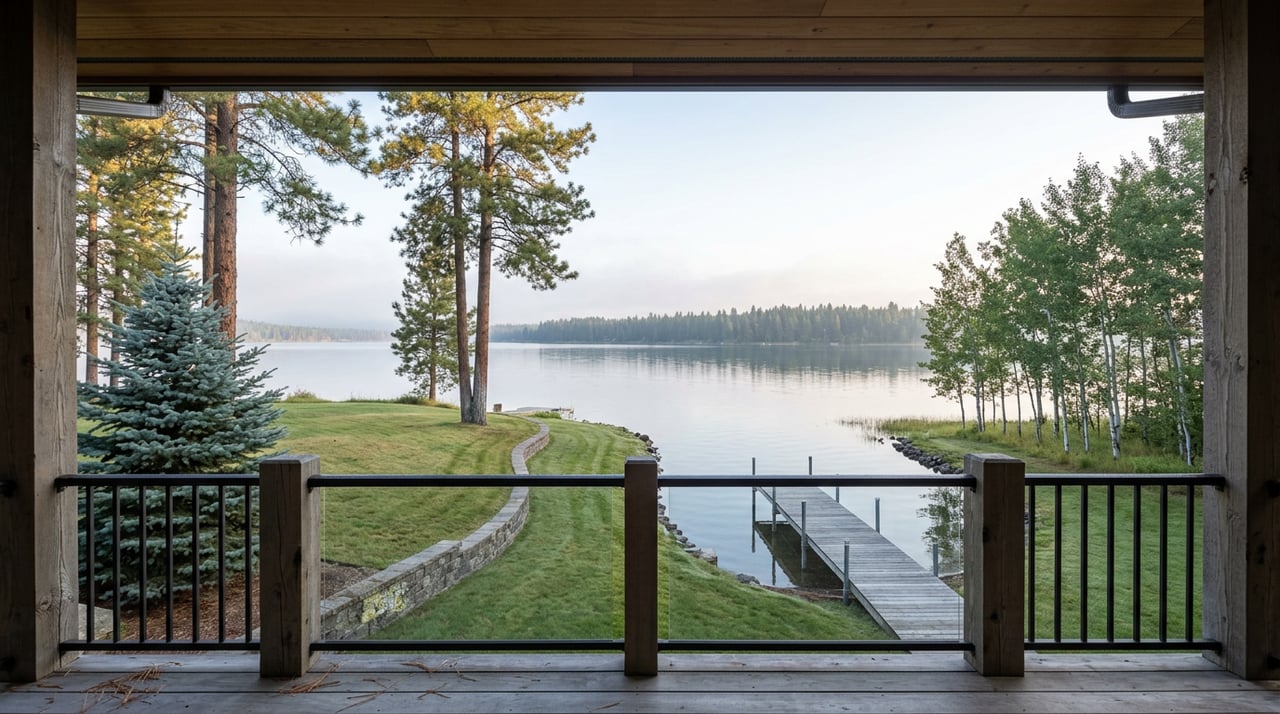
A buyer looking at a five-bedroom place near Payette Lake called McCall's planning department in early August, ready to ask about the conditional use permit the city has required since 2022 for any short-term rental sleeping more than 11 people. The permit used to run $3,200, on top of an annual fire inspection and a requirement that owners keep a contact on call 24 hours a day who could reach the property within 60 minutes of a neighbor's complaint. The person on the other end of the line said the city doesn't require that permit anymore.
That conversation is playing out across McCall this summer, and it's the reason anyone shopping for a cabin with rental income in mind needs to update what they think they know about this market. The state legislature erased most of the paperwork. It did not erase the thing that will actually decide whether a given property can be rented by the week.
What the state actually erased
House Bill 583, signed by Governor Brad Little on March 16, 2026, took effect July 1 under an emergency clause. It rewrote Idaho Code Section 67-6539 to bar cities and counties from imposing rules on short-term rentals that they wouldn't also impose on long-term rentals. McCall built one of the most detailed STR frameworks in the state back in 2022, which made it one of the cities most directly affected.
Here's the practical shift for anyone evaluating a McCall property:
| Under McCall's 2022 ordinance | Under state law as of July 1, 2026 |
|---|---|
| Special STR permit required, with a conditional use permit (roughly $3,200) for homes sleeping more than 11 | Cities cannot require an STR-specific license, permit, fee, or registration |
| 24/7 rapid-response contact required to reach the property within 60 minutes | Local governments cannot mandate owner-presence or a professional property manager |
| Annual fire safety inspection tied to STR permitting | Basic life-safety rules (smoke alarms, CO detectors, fire extinguishers, escape ladders) still allowed, applied evenly to all housing |
| City could require extra insurance and usage reporting | Prohibited unless applied to long-term rentals too |
The city can still enforce noise, parking, and nuisance ordinances the same way it would for any residential address. What it lost is the ability to treat a rental-by-the-week differently from a rental-by-the-year just because of how long the guest stays.
McCall's mayor, Colby Nielsen, publicly opposed the bill before it passed, arguing the city had built a framework that balanced property rights against the effects of high guest turnover on residential streets. That framework is largely gone now, at least the part the city controlled directly.
The rule that didn't move
Here's what a lot of out-of-state buyers miss. HB 583 preempts government regulation. It does not touch private agreements between property owners, which means HOA covenants, conditions, and restrictions still govern whatever they said before the law changed, and they'll keep governing after. If a subdivision's recorded CC&Rs prohibit rentals under 30 days, that restriction stands no matter what the state legislature did in March.
This matters more in McCall specifically because of what's coming next. The McCall Planning and Zoning Commission approved an updated mixed-use development plan overlooking Payette Lake earlier this year, and a separate proposal for more than 700 homes and a commercial village southwest of town is expected to get a decision this fall. Every one of those developments will be written with its own covenants, and now that the city can't use zoning to control short-term rental behavior at the parcel level, developers have more reason than ever to write that control into the declaration itself. The regulatory lever didn't disappear. It moved from city hall to the developer's attorney.
That's the diligence step that changed. Before July 2026, a McCall STR buyer checked with the planning department. Now the planning department may not have an answer, and the document that actually controls your rental plans is sitting in the HOA's recorded declaration, not on a city permit list. Request it before you write an offer, not after closing.
One more wrinkle worth knowing: existing violation notices and prior enforcement actions don't automatically disappear because the underlying ordinance was preempted. If a property carries an open compliance issue from before July 1, that history doesn't reset itself just because the rule that created it did.
Reading three price reports and getting three different answers
If you've pulled McCall numbers from more than one source this summer, you've probably noticed they don't agree, and that's not a data error. It's a sign the market is segmented in a way a single median can't capture.
One tracker puts McCall's median sale price at $730,000 over the three months ending in May 2026, down about 6.5 percent year over year, with homes averaging 77 days on market compared to 45 days the year before. Another source lists McCall's median list price at $874,900 as of March 2026. By August, a different tracker had the median list price above $1.1 million. None of these are wrong. They're measuring different slices of the same town at different moments, and the slice matters. A three-month closed-sale median leans toward whatever actually changed hands, which in a slow season tends to be smaller cabins and condos near town rather than custom lakefront builds that sit longer and trade less often. A list-price median in a single month reflects whatever just came on the market, and if a handful of larger custom homes hit the MLS that month, the number jumps even if nothing about buyer demand changed.
A weekly market tracker put McCall's median list price at $1.34 million in mid-July, with a Market Action Index around 32, down slightly from 33 the month before, and inventory up to 100 listings. That index has been drifting lower for weeks while prices held steady, which typically means a market cooling from a seller's advantage toward something closer to balanced, not a market turning over quickly. For a buyer weighing an STR purchase, the useful read isn't the headline median. It's that inventory is loosening enough to negotiate on condition and terms, particularly on entry-level cabin stock, while the custom and lakefront segment still moves on its own schedule.
Before you write an offer
- Request the HOA or subdivision's recorded CC&Rs directly from the association, not just a summary from the listing agent
- Ask the HOA board in writing whether short-term rentals under 30 days are currently permitted, and get that answer before your inspection period closes
- Check whether the property carries any open code violation or enforcement history predating July 1, 2026
- Confirm current lodging tax obligations directly with the city, since HB 583 changed permitting but not McCall's local-option lodging tax
- If you're buying into new construction, read the developer's draft declaration before you assume anything about rental use, since covenants for projects still in approval can be written however the developer chooses
FAQ
Does HB 583 mean any McCall home can now be rented short-term? No. Zoning still applies, and any HOA or subdivision covenant restricting rentals remains fully enforceable. The law removed the city's ability to impose STR-specific permits and fees, not private agreements or land use classifications.
Do I still owe lodging tax on a McCall rental? Yes. McCall is listed by the Idaho State Tax Commission as a city with a local-option lodging tax, and that tax structure is separate from the permitting rules HB 583 addressed. Confirm the current rate and filing process directly with the city before you list a property.
Could McCall or other resort cities push back on this law? Some lawmakers acknowledged during debate that the issue is far from settled, and the Idaho Resort Cities Coalition, which includes McCall, has signaled it will keep raising the issue. Nothing currently pending would change the rules for a purchase you're making today, but it's worth knowing the legislative fight isn't necessarily over.
If you're weighing a McCall purchase with rental income in mind, or you just want someone to help you read a subdivision's covenants before you're three weeks into a closing, The Canterbury Group works these questions with buyers across McCall and the wider Treasure Valley every week. You can start with our McCall neighborhood guide or reach out directly. We'll tell you what the HOA actually says before you fall in love with the listing photos.